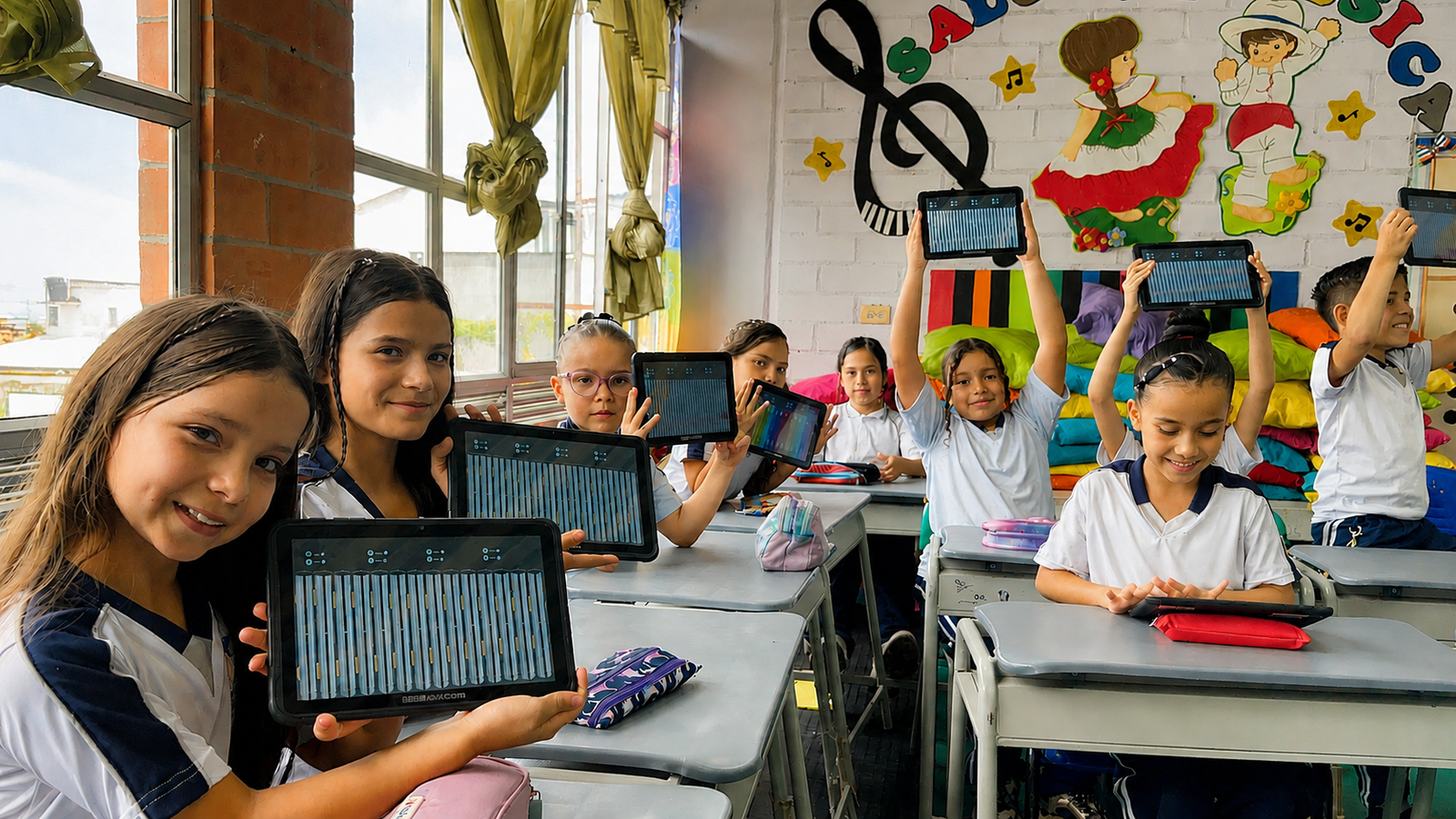
In an early-years classroom in Armenia, two preschool girls trace a coloured path together on a touch table. A few metres away, a teacher opens her mathematics plan on an eighty-six-inch display and starts the lesson without first checking whether there is a signal. Both scenes belong to the same project — the city's SITE classrooms — and run on the same digital ecosystem: AVACOM's, now operating in all twenty-eight public schools in the city.
What sits inside every room
The ecosystem is not a stray device but a set that behaves as a single tool. Each classroom has an eighty-six-inch interactive display running two operating systems, thirty student tablets and one for the teacher, and a charging unit that leaves them ready for the next lesson. In the early-years grades the centre of gravity drops: there the rooms get forty-three-inch interactive tables, built so several children can learn and play around the same surface. Every piece is where it is because it answers to an age and a way of working.
The lesson goes on even when the network does not
The component you see least is the one that carries the most weight day to day. Each school has a server holding more than eighty thousand navigable teaching resources that work offline, and that detail changes how teachers relate to the technology: they stop planning around whether the internet will hold and start planning around what they want their students to learn. In a department where connectivity is not the same everywhere, that independence is the difference between a tool and an ornament.
A full rollout, not a pilot room
What makes Quindío different is the scale: Armenia did not fit out one model classroom per school, but every classroom in its public institutions. That means hundreds of rooms running daily and hundreds of teachers learning at the same time, with resources that arrive preloaded and aligned with the Ministry of Education's guidelines and technical support close by when something gets in the way. A recent piece in El Quindiano stopped precisely at what comes after the equipment — changing the way we teach — and it is an observation we share: technology opens the door, and pedagogical work is what walks through it.
The full El Quindiano piece is worth reading. It develops that argument in detail and brings a local newsroom's view of a rollout that is only beginning to show what it can do.
Original source: El Quindiano · SITE classrooms in Armenia(opens in a new tab)